James Patrick Thomas, Atomic Pilgrim
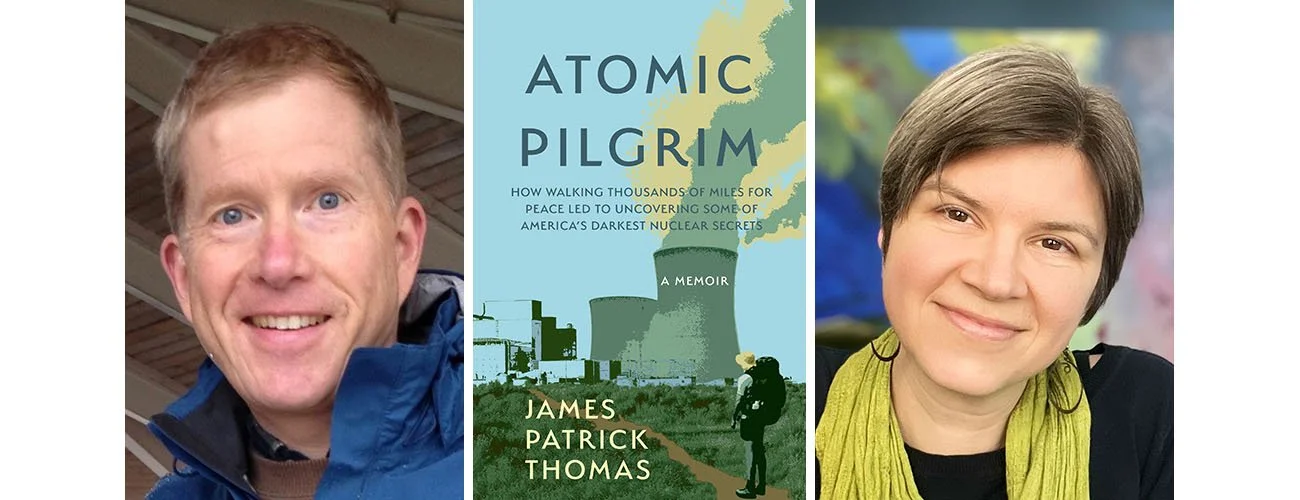
Join us at the Phinney Center to celebrate the launch of our neighborhood author James Patrick Thomas’s memoir, Atomic Pilgrim: How Walking Thousands of Miles for Peace Led to Uncovering Some of America's Darkest Nuclear Secrets. James will be in discussion with Shannon Cram, associate professor at the University of Washington, Bothell and author of Unmaking the Bomb.
To order a signed copy of Atomic Pilgrim, either to pick up at the event or to be shipped, click here.
Atomic Pilgrim is the story of how one person's faith, actions, and persistence can impact seemingly immovable systems and hold even the most powerful bureaucracies to account. James Patrick Thomas's path toward nuclear disarmament began on Good Friday, 1982, when he and his fellow peace pilgrims started walking away from the Trident Nuclear Submarine Base near Seattle. Their Bethlehem Peace Pilgrimage would span 6,700 miles across the United States and nine other countries, each step aimed at ending the nuclear arms race. After two years on the road, Jim continued his pursuit of peace and disarmament. Back in Spokane, Washington, Jim turned his attention toward the Hanford plutonium factory—one of the original Manhattan Project sites just 110 miles from his home. Over the next two decades, Jim helped uncover stunning revelations about Hanford's toxic regional impact and its role in our nation's nuclear weapons complex.
While serving in the Jesuit Volunteer Corps, James Patrick Thomas began advocating for nuclear disarmament as a member of the Bethlehem Peace Pilgrimage. He spent the next quarter century investigating radioactive pollution from the production and testing of nuclear weapons, mostly focused on the Hanford Site in south-central Washington State. He organized a national coalition that forced the federal government to close Hanford's plutonium operations in 1990, served on several federal advisory committees concerning radiation health effects, and worked for ten years as a paralegal for the plaintiffs in the Hanford downwinders litigation. Jim directed life, justice, and peace ministry for the Diocese of Spokane (1984-1987), the Archdiocese of Seattle (2007-2015), and the Washington State Catholic Conference (2015-2020). He has a master's in religious studies from Gonzaga University. He has visited Hiroshima and Nagasaki twice—in 1993 he spoke at an international conference on plutonium processing and in 2023 he accompanied Archbishops Paul Etienne and John Wester on their Pilgrimage of Peace. He lives in Seattle with his wife and daughter.
Shannon Cram is an associate professor of Interdisciplinary Arts and Sciences at the University of Washington, Bothell, where she co-directs the Science, Technology, and Society program. Her first book, Unmaking the Bomb: Environmental Cleanup and the Politics of Impossibility, was named a Best Indie Book of the Year by Kirkus Reviews and a finalist for the Washington State Book Award. She is currently working on a new project about genetic mutation and previvorship.














![[POSTPONED] The Process: Alex Gallo-Brown, Billie Swift, Bill Carty](https://images.squarespace-cdn.com/content/v1/53307b46e4b01e0cfc001f75/1577745587382-K93JY11X5VSEV1LCYHIY/Process_January20.jpg)
![[CANCELED] Ridge Readers Book Club: House of Rain](https://images.squarespace-cdn.com/content/v1/53307b46e4b01e0cfc001f75/1574807506191-SWLVFZFX90CYMERH89FY/Childs_House.jpg)
![[POSTPONED TO JUNE 9] The Process: Anne Liu Kellor, Adrienne Matthews, Kathryn Thurber-Smith](https://images.squarespace-cdn.com/content/v1/53307b46e4b01e0cfc001f75/1583006683047-J2RXTA6BS79L3KDF7QVG/Kellor_Matthews_Thurber.jpg)