
Tom’s 2025 Top 12
Tom’s twelve favorite reads from 2025 (not necessarily published in 2025) in alphabetical order by author.
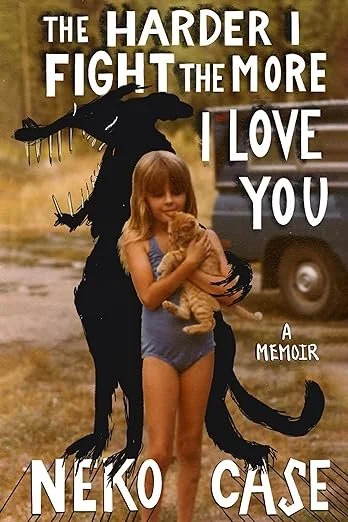
The Harder I Fight the More I Love You: A Memoir
by Neko Case
"What makes you think you're so important that someone should listen to you?" It's the question Neko Case has been asked—and even worse, asked herself—her whole life, born into a spectacularly neglected childhood ("raised by two dogs and a space heater") and bounced around the rural Northwest until she found her people and her voice in the Tacoma punk scene. If you love her singing and her songwriting, it's inconceivable you won't love this starkly beautiful book, but even if you've never heard her (you should!) you'll likely never forget the childhood she recalls and the person she became. It's my favorite book I've read so far this year—easily.
Theory & Practice
by Michelle de Kretser
Recently I sifted through our new releases in search of—well, I wasn't sure. A certain kind of book I knew I needed without quite knowing what it was. And this little novel, I realized almost as soon as I picked it up, was it. Can I describe it now? I'm still not sure, but what comes to mind first is "restlessly intelligent." An Australian woman from Sri Lanka studies Virginia Woolf in grad school, and has an irrationally possessive affair with a young man who is, mostly, seeing someone else. It's a story very much about what the title says—the gap, the friction, between theory and practice—but really it's about the grit and the thought of this particular life, looked back on from afar. If you liked Claire Dederer's Monsters (and I know many of you did), you'll find a fictional companion here, somewhat in subject but certainly in that shared restless intelligence.
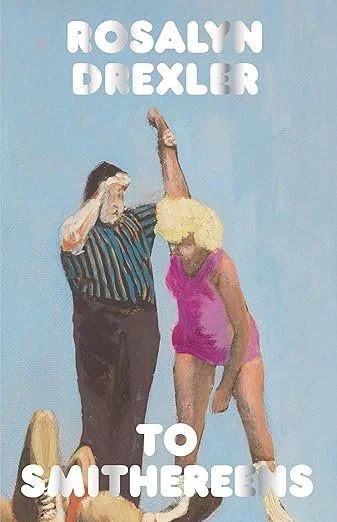
To Smithereens
by Rosalyn Drexler
I had never heard of Rosalyn Drexler before I opened this novel, published in 1972 and reissued this year as the first book from the cool new imprint Hagfish, but she seems like a heck of a woman. Mostly a painter who made her own way through the fist-fighters of Abstract Expressionism and Pop Art (the cover painting to the left is hers), she also has written plays and a dozen or so books in her 98 years (including the novelization of Rocky!), and, like her character Rosa Rubinsky, was for a time a pro wrestler on the sleazy, pre-TV circuit. Writing may have been second to painting for her, but whoa, she can write: To Smithereens is a raunchy, ratty tale that reads a little like The Queen's Gambit seen through the eyes of R. Crumb, and then seen again through the eyes of a savvy, seen-it-all feminist. It's satirical but surprisingly humane toward even its creepiest characters, and best of all, Drexler has a deliciously spot-on ear for the way people talk and think. I loved it.

One Day, Everyone Will Have Always Been Against This
by Omar El Akkad
To say that this book began as a tweet—a single sentence posted in late October 2023, a little longer than what became its title but the same in spirit—is not to belittle it, but to capture the power of its focused eloquence. El Akkad, author of the provocative near-future novel, American War, expanded on that sentence in this nonfiction memoir/polemic not with the usual back-and-forth of Middle East historical blame but by tracing his own path: from a childhood in Egypt, Qatar, and Canada to an adult decision to become a citizen of the United States. It was a path driven in part by opportunity and the appeal of a more open society, but now, after two decades of reporting on empire and the unrelenting evidence of the destruction of Gaza, his understanding of the hypocrisy of the West and its indifference to the suffering of others becomes almost a koan of anger and anguish, tempered only slightly by the hope that there will be a future that might, at some point, see it for what it was.
Is a River Alive?
by Robert Macfarlane
If rivers can die—we've all seen that they can—shouldn't that also mean that rivers are alive? Macfarlane's newest book is his most pointedly provocative, adding an activist's urgency to his usual, miraculous attention to nature, love for language, and charismatic generosity toward the best of his fellow humans. In this participatory study of living waterways, almost giddy with hope and the possibility of despair, you'll meet four river systems, in the cloudforests of Ecuador, the polluted flatlands of India, the wild, yet-undammed reaches of Quebec, and Macfarlane's home territory of Cambridge, and you'll also get to know some of the larger-than-life people who love and try to protect them. In a time when we pay particular attention to pronouns, you'll note the one he insists on using for each river: not "it," but "who."
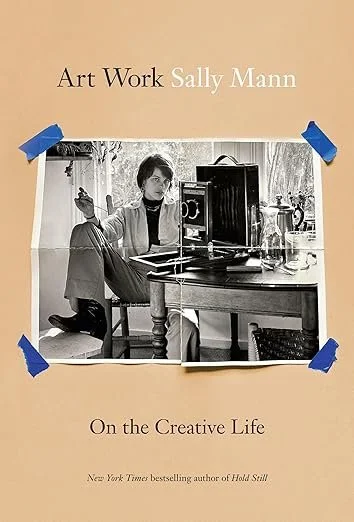
Art Work: On the Creative Life
by Sally Mann
There's something about the particular eloquence of Sally Mann's photographs—their locality, their intimacy, and the sense you get of her as not merely a silent, reserved observer but a real participant in her compositions—that makes it unsurprising she is such a good writer too. The first evidence was her 2011 memoir, Hold Still, a National Book Award finalist; the second is this book, which she thought she'd never write until she found herself jotting chapter headings. It's presented as an artistic self-help book, and it reminded me of my favorite in that genre, Twyla Tharp's The Creative Habit, in its attention to both the practical and passionate sides of long-term art-making. But Mann is such a personal artist, and such a natural storyteller, that inevitably this is another memoir of sorts, adding to her life story and revisiting her obsessions with place and family and the joys and the grind of creation.
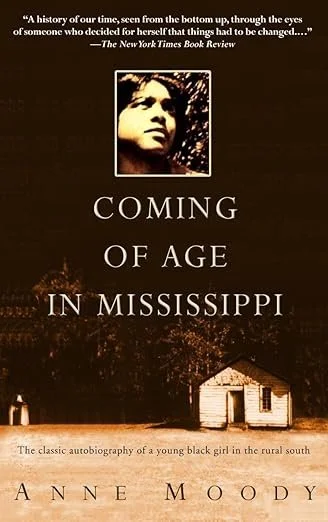
Coming of Age in Mississippi
by Anne Moody
Although she worked alongside civil rights legends like Bob Moses and Medgar Evers, you won't find Moody's name in the indexes of the big histories of the movement, and her memoir doesn't follow the arc of progress those histories trace. It's a story of frustration as much as success, of exhaustion as much as exhilaration. It's a view, not from above the ocean waves, but from inside the churn of the surf, where you can't tell if you are moving forward or backward, up or down. But it's a moving and rousing story nevertheless, as Moody, from early childhood, chafes against nearly everything in her poor rural upbringing, fights for her education and earning power, and finds a purpose—even if an often thwarted one—in political action and community.
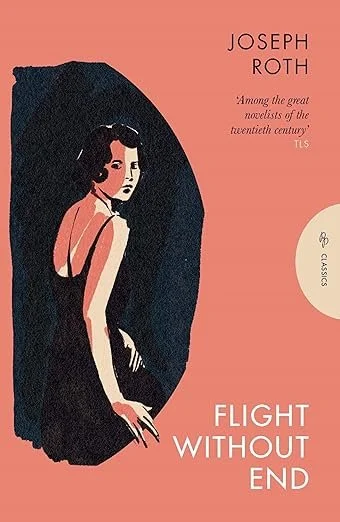
Flight Without End
by Joseph Roth
I am slowly catching up with the genius of Joseph Roth. After the multigenerational sweep of his masterpiece, The Radetzky March, this little novel reads like a minor chamber piece, but in some ways it burrowed under my skin more deeply. It's the story, such as it is, of a certain Franz Tunda—a bourgeois young Austrian officer, engaged to a suitable bride, whose life goes thoroughly sideways when he is taken as a prisoner of war and escapes to a new identity in Siberia. Possessed by a strangely indifferent restlessness, he finds himself a Soviet revolutionary, then a husband in Baku, and finally a sponger and a vagrant in Vienna and Paris: a perfectly modern man, and an utterly "superfluous" one. It's an oddly unsettling, and often drily hilarious, story.
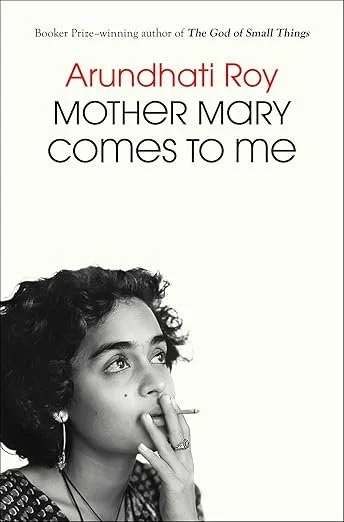
Mother Mary Comes to Me
by Arundhati Roy
In the wake of the fame granted by her bestselling, Booker-winning debut novel, The God of Small Things, Roy has mostly turned her writing to political reporting and activism. But the death of her mother, a larger-than-life figure who left her feckless husband and built an acclaimed school from the sheer force of her will while cascading a constant stream of insults toward her own children, drove Roy to tell the story of her own life. It's dramatic, funny, thoughtful, and more earthily practical than her lush fiction—especially when narrated in her own drily witty voice in the audiobook. As domineering as "Mrs. Roy" was (she commanded her children to call her the same name her other students used)—"my shelter and my storm," her daughter says—Arundhati herself is an equally forceful figure, making her way out of that storm and then reckoning with the surprising dangers of her own fame and fortune. It's marvelous.
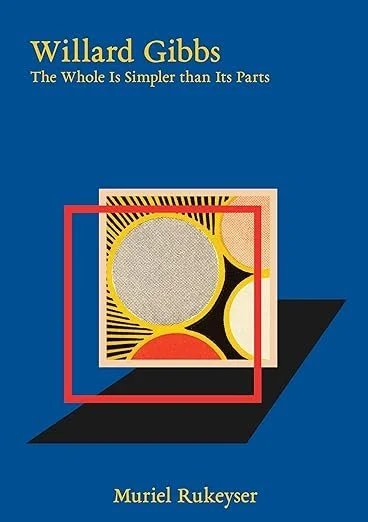
Willard Gibbs: The Whole Is Simpler than Its Parts
by Muriel Rukeyser
This hefty, beautiful, and mysterious book tempted me from across the store for months, and when I finally had the time to sit down with it, it turned out to be all of those things: hefty, beautiful, and still mysterious. The first book in Maria Popova's new Marginalian imprint for the excellent McNally Editions, it's a biography (of sorts) of the 19th-century scientist Willard Gibbs, first published in 1942 by the poet Muriel Rukeyser. Gibbs was a titan—Rukeyser, not outlandishly, counts him as one of the four great Americans of his time, along with Lincoln, Whitman, and Melville—but largely unknown then and still so now, even as his ideas, in their brilliant connection and abstraction across mathematics, physics, and chemistry, laid the foundation for much of what the 20th century discovered. "A modest man," in Rukeyser's words, "living and dying in the space of three New Haven blocks," his life story is almost vacant, so she makes it a biography of an entire age, of industrial and social transformation and of brainy, searching peers like William James and Henry Adams. It is a dense, lyrical, fascinating book, full of science that largely flew over my head and cultural history as wise as any I've read. That Rukeyser wrote it all by the time she was 29 is astounding, and makes me even more curious about her than about her elusive subject.

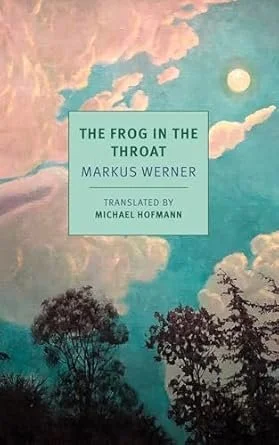
The Frog in the Throat
by Markus Werner, translated by Michael Hofmann
We pay attention to Michael Hofmann's translations here, not only for his skill in turning German into English (e.g., Joseph Roth's The Radetzky March and Jenny Erpenbeck's Kairos) but for his taste in the books he chooses to translate. So when, in the introduction to this book, he described Werner, a Swiss novelist I hadn't heard of before, as "exquisitely addictive," as "swift," "bleak," and "deadly," well, I had to keep reading. And I acquired an appetite for Werner too, which likely won't be satisfied with this one book. The story is slight, alternating between the voices of a lapsed, disgraced pastor and his late dairy-farmer father, who refuses to forgive his son even in death, but it's the voices that are the pull, grouchy rants worthy of Thomas Bernhard or Michel Houellebecq that are somehow refreshing and even humane in their flaws and fury. I don't remember when bitter misanthropy has made me so glad to be alive.